
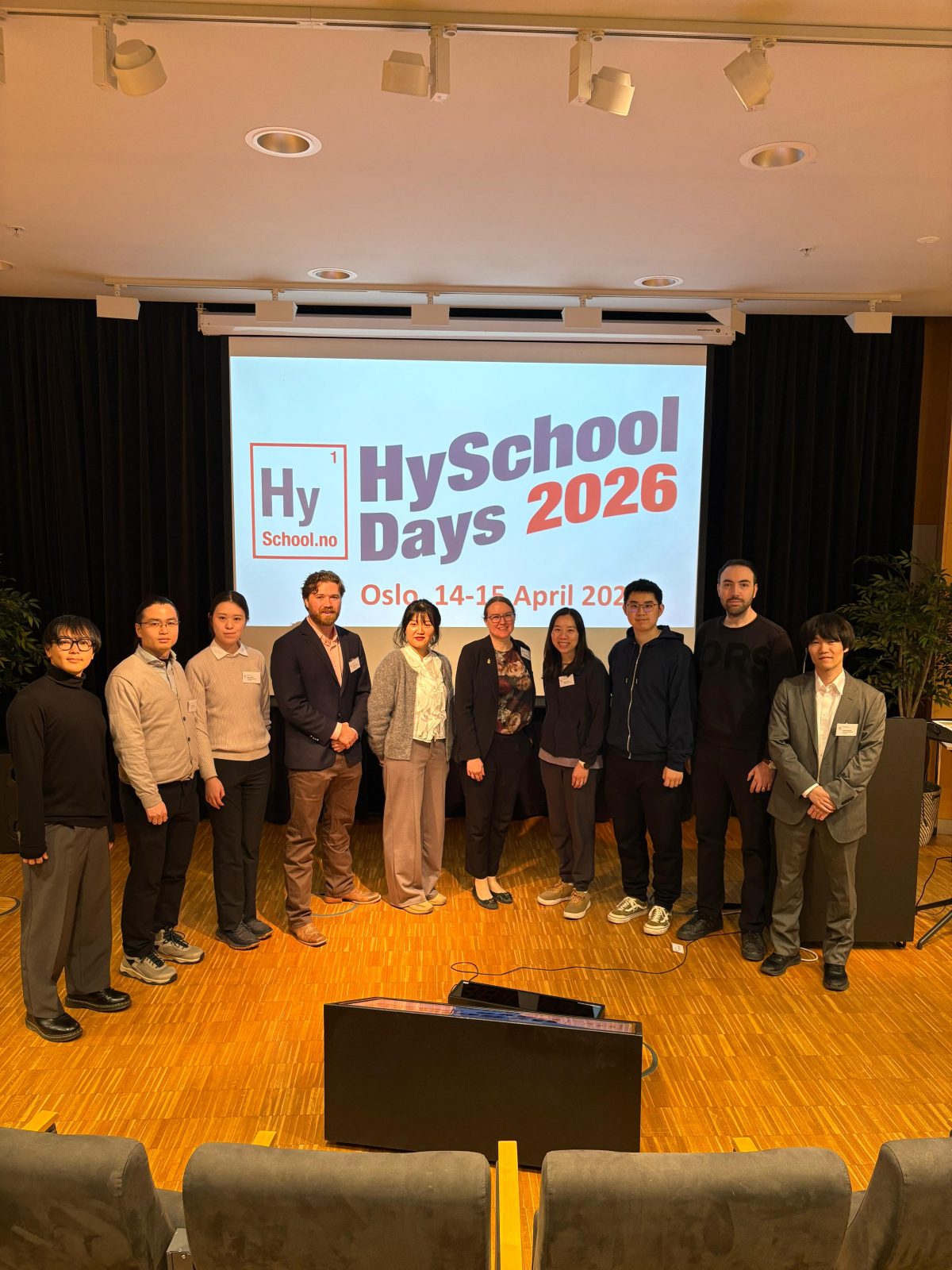
Students Participate in HERCULES Workshop and HySchool 2026 in Oslo, Norway
Doctoral student Eisuke Takano (D3) and master’s student Rena Tajima (M1) from the Shibutani Laboratory, Yokohama National University, participated in the HERCULES Workshop and HySchool 2026 held in Oslo, Norway. The visit provided valuable opportunities to exchange ideas with researchers and students working in the fields of hydrogen energy, safety engineering, and risk assessment.
The HERCULES Workshop was held at Science Park Oslo and brought together researchers and students from several international partner institutions, including the University of Maryland, the University of Toronto, the Norwegian University of Science and Technology (NTNU), and Yokohama National University. During the workshop, participants presented the latest progress in their research projects and discussed future collaborative activities.
As part of the workshop activities, Rena Tajima presented her research on the probabilistic risk assessment of liquefied hydrogen storage tanks and the functional safety assessment of emergency shutdown systems (ESS). Her presentation addressed quantitative approaches for evaluating hydrogen storage safety and discussed the application of fault tree analysis and reliability assessment methods for safety-critical systems.
The students also attended HySchool Days, organized by the Norwegian Research School on Hydrogen and Hydrogen-Based Fuels. The program included lectures and presentations covering a wide range of hydrogen-related topics, including hydrogen production, industrial applications, aviation fuels, and hydrogen safety. The event provided participants with an excellent opportunity to learn about the latest developments in hydrogen technologies and to interact with leading researchers in the field.
A highlight of the program was an industrial excursion to Hystar, a Norwegian company developing high-efficiency electrolyzers for green hydrogen production. Participants were able to gain first-hand insights into industrial-scale hydrogen technologies and discuss current challenges and future opportunities for the hydrogen economy.
Throughout the week, the students engaged with researchers from institutions such as the University of Oslo, the University of Stavanger, NTNU, the Arctic University of Norway, the University of Toronto, and the University of Maryland. These interactions helped strengthen international research networks and opened new possibilities for future collaboration in hydrogen safety and risk science.
The experience provided valuable opportunities not only to present research findings but also to deepen international partnerships and gain broader perspectives on emerging hydrogen technologies. The knowledge and connections obtained during the visit will contribute to the continued advancement of research activities within the Shibutani Laboratory.