
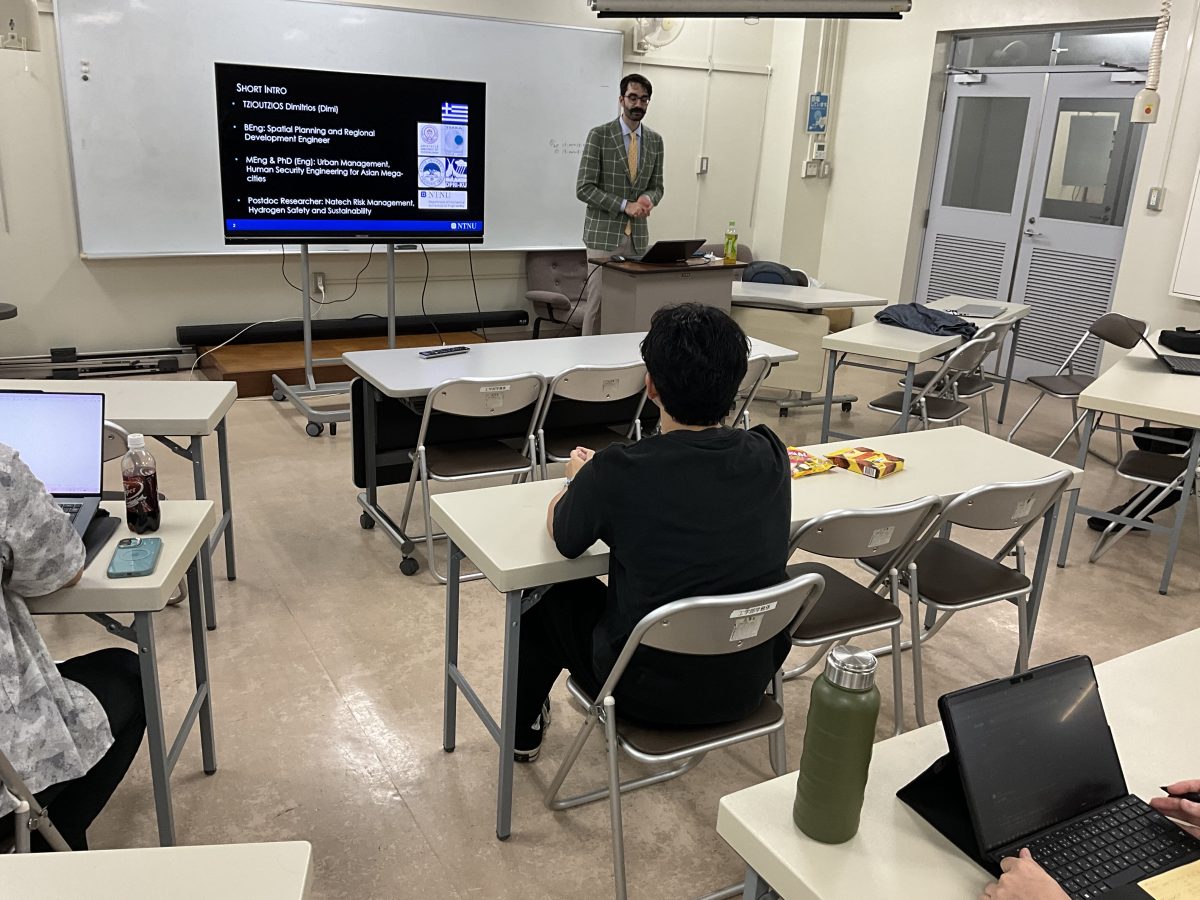
On September 15, 2026, a seminar presented by Dimitrios Tzioutzios from the Norwegian University of Science and Technology (NTNU) was held at Yokohama National University. Faculty members and students from YNU attended the seminar and engaged in active discussions on the challenges of risk management and hydrogen safety.
Titled“Risk Management for Resilient Infrastructure and Hydrogen Systems,” the seminar introduced recent research efforts aimed at improving the safety and resilience of critical infrastructure and emerging hydrogen energy systems. The presentation covered a wide range of topics, including historical dam failure analysis, Natech (Natural Hazard Triggering Technological Disasters) risks in hydrogen pipelines, storm-induced vulnerabilities of liquid hydrogen storage systems, offshore hydrogen and ammonia energy storage safety, and accident analyses of hydrogen refueling stations.
Particular attention was given to hydrogen safety, an increasingly important issue as hydrogen is expected to play a key role in the transition toward a carbon-neutral society. The seminar highlighted how natural hazards such as floods, storms, lightning, and landslides can affect hydrogen infrastructure and discussed advanced methodologies for assessing and mitigating these risks. Recent findings from European research projects on liquid hydrogen storage, hydrogen transportation, and hydrogen refueling stations were also presented.
Dimitrios Tzioutzios is a researcher specializing in Natech risk management, disaster prevention, and hydrogen safety within the NTNU RAMS (Reliability, Availability, Maintainability and Safety) Group. He is involved in several major European and Norwegian hydrogen research initiatives, including projects on hydrogen infrastructure safety, liquid hydrogen storage, and hydrogen education and training. He has authored more than 40 international scientific publications and is actively contributing to the development of safer and more resilient hydrogen technologies.
The seminar provided valuable insights into the latest international research trends in hydrogen safety and risk science and offered an excellent opportunity for participants to exchange ideas on future collaboration between YNU and NTNU. Through our research in safety engineering and risk science, our laboratory will continue its efforts to improve the safety, reliability, and resilience of hydrogen energy systems and other critical infrastructures.